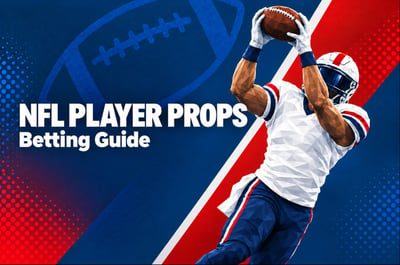
How to Bet NFL Player Props
The best NFL props are won on a player's role and the game script, not on what he did last week.
Player props are bets on one player's numbers in one game - a quarterback's passing yards, a receiver's catches, whether a running back scores. They're the fastest-growing part of NFL betting, and they're where I find the most value, because sportsbooks post hundreds of lines a game and can't price every one as sharply as the spread.
This guide covers how to bet NFL player props, from reading your first line to how the bets are settled. The examples use real prices from Monday Night Football in Week 8, the Chicago Bears at the Seattle Seahawks.
What Is an NFL Player Prop
A prop sets a line on a player's stat, and you bet over or under it. Most lines end in .5, so there's no push.
Take Jaxon Smith-Njigba's receiving yards on Monday night. The line was 101.5, with the over at 1.901 and the under at 1.885. If he finishes with 102 yards or more, the over wins. At 101 or fewer, the under wins.
The line isn't a prediction of what he'll do. It's the number that the sportsbook thinks will split the betting, which is usually close to what the market expects.
Some props have no line at all. An anytime touchdown bet is a simple yes - does he score or not.
The Main NFL Prop Markets
Quarterback props
- Passing yards - the most popular QB prop. Sam Darnold was at 236.5 and Caleb Williams at 231.5 on Monday.
- Passing touchdowns - usually set at 1.5, so the bet is really whether he throws two or more.
- Interceptions - most often at 0.5, a bet on whether he throws one at all.
- Rushing yards - worth a look for mobile quarterbacks. Williams was at 23.5.
- Completions and attempts - lower-profile lines that follow the expected game script.
Running back props
- Rushing yards - D'Andre Swift was at 59.5 for Chicago, the league's top rushing offence.
- Rushing attempts - a cleaner read on workload than yards.
- Rushing plus receiving yards - suits backs who catch passes out of the backfield.
Receiver and tight end props
- Receiving yards - the biggest receiver market.
- Receptions - catches, not targets. Smith-Njigba was at 7.5.
- Longest reception - one big play settles it, which makes it volatile.
Touchdown props
- Anytime touchdown scorer - the player scores at any point, including overtime. Swift and Smith-Njigba were both priced around 1.87 to 1.91.
- First touchdown scorer - much longer prices, because only one player can win it.
- Two or more touchdowns - a long-shot version of the anytime bet.
Defensive and kicking props
- Sacks, tackles, interceptions and field goals made are all on offer. The lines are thinner and the stats are noisier, so I treat them as a small part of the card.
How to Read a Prop Line
Every price converts to an implied probability. Divide 1 by the decimal odds.
The Smith-Njigba over at 1.901 implies 52.6%. The under at 1.885 implies 53.1%. Add them together and you get 105.7%, and that extra 5.7% is the sportsbook's margin.
When both sides are close to 1.90, the market sees the line as a near coin flip. When the prices split, it's telling you which way it leans.
His receptions line showed that. The over 7.5 was 2.10 and the under 1.709, which implies 47.6% against 58.5%. The sportsbook kept the line at 7.5 but moved the price, because it thought seven or fewer catches was more likely than eight or more.
To bet a prop well, you need your own number. If you think the over has a 58% chance and the price implies 52.6%, that's the gap you're betting on. If you can't say why your number is different from the market's, you don't have an edge.
Alternate Lines and Ladders
Most sportsbooks offer alternate lines on the big props, so you can choose your own number and take a different price.
Here's Swift's rushing yards ladder from a Monday night game.
| Swift rushing yards | Price | Implied probability |
|---|
| Over 49.5 | 1.529 | 65.4% |
| Over 59.5 | 1.909 | 52.4% |
| Over 69.5 | 2.49 | 40.2% |
| Over 79.5 | 3.30 | 30.3% |
| Over 99.5 | 6.12 | 16.3% |
Alternate lines are useful when you have a strong view on a big game. If you expect a back to get 25 carries in a game his team should control, the 79.5 rung pays far more than the main line.
The catch is that the margin is often bigger on the far rungs. A ladder doesn't create value on its own. It only lets you bet the number your read supports.
Shop the Number
Props differ between sportsbooks more than sides and totals do, and it's often the line that differs, not just the price.
On Monday night, Smith-Njigba's receiving yards were 101.5 at one sportsbook and 99.5 at another, both priced around 1.89. Williams' passing yards were 231.5 at one and 227.5 at another.
Two yards doesn't sound like much. But a receiver who finishes on 100 or 101 yards wins the over at 99.5 and loses at 101.5, at the same price. If you bet props regularly, having more than one account to compare is the simplest edge there is.
What Moves an NFL Prop Line
Role and workload
Snap share, routes run, targets and carries tell you more than last week's yardage. A receiver who ran a route on nearly every pass play and drew a quarter of the targets is a stronger over candidate than one who had 120 yards on four catches.
Game script
The spread and total shape every prop. Seattle were 3-point favourites with a 46.5 total, and the team totals were set at 24.5 for the Seahawks and 21.5 for the Bears.
A favourite with a lead tends to run the ball late, which helps its running back's rushing yards. A team that falls behind throws more, which can lift a quarterback's passing yards even in a loss.
Injuries and inactives
When a team's top receiver is ruled out, his targets go somewhere. The next man up often gets the volume before the line fully catches up, especially when the news breaks late in the week.
Inactive lists come out about 90 minutes before kick-off. A surprise inactive can move several props in the same game at once, so check the official injury report before you bet.
Weather
Strong wind hurts passing and kicking more than rain or cold. If the forecast turns windy, passing yards and field goal lines can drop through the week, and running back props can rise.
How NFL Props Are Settled
Read your sportsbook's rules before you bet, because they vary. These are the most common ones.
- The player has to play. If he doesn't take a snap, most sportsbooks void the bet and return your stake. If he plays one snap and gets hurt, the bet usually stands.
- Overtime counts on full-game props.
- Sacks don't reduce a quarterback's passing yards. Individual passing yards are counted before sacks, so a sack doesn't cut into his passing total.
- Kneel-downs count as rushing. A quarterback who takes three kneels at the end of a win can lose a few rushing yards.
- Passing touchdowns don't count for anytime scorer bets. The player has to run, catch or return the ball into the end zone himself.
- Official stats settle the bet. Most sportsbooks grade on the official numbers at the end of the game. Their rules on later stat corrections differ.
Props in Parlays and Same-Game Parlays
Props are the building blocks of most same-game parlays. A quarterback's passing yards over and his top receiver's receiving yards over tend to land together, and sportsbooks know it.
That's called correlation, and same-game parlay pricing accounts for it, so the combined price is shorter than multiplying the legs together. The more legs you add, the more margin you pay.
Our Same-Game Parlays Explained and Parlays Explained guides go deeper.
NFL Prop Betting Tips
Bet the role, not the box score. Targets and carries are steadier from week to week than yards and touchdowns.
Remember that yardage props are lopsided. One long catch can carry a receiver well past his line, but the floor is zero. That's why unders on receiving yards are worth more of a look than most bettors give them.
Wait for team news when you can. The best props are often bet after a late injury opens up targets or carries.
Don't stack one game. Five props from the same game are really one bet on how that game goes.
Keep your stakes level. Prop prices are bigger than sides, but that's not a reason to bet more. Our Bankroll and Unit Sizing guide explains how.
How We Pick NFL Props
Every NFL prop on Expert Picks is published before kick-off at the price in the article, and graded against the official result. Our weekly NFL Player Props of the Week gives our best picks for each slate, and our
How to Bet on the NFL guide covers spreads, totals and the rest of the NFL menu.