






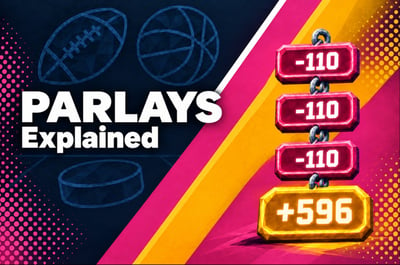
Parlays Explained - How Parlay Betting Works
A parlay is one bet made up of two or more picks, called legs. Every leg has to win for the parlay to pay, and in return the prices multiply together, so the payout is much bigger than any single bet.
That's the trade. Two picks at -110 pay +264 as a parlay, close to four times your stake back. Lose either leg, though, and the whole bet loses.
This guide covers how parlay odds are worked out, what happens when a leg pushes, why the margin grows with every leg, and when a parlay makes sense. The examples use real prices from this weekend's NFL and college football games.
How a Parlay Works
Take three spreads from this weekend, all priced at -110.
- Detroit Lions -6 against the Tampa Bay Buccaneers, Sunday at 1 p.m. ET
- Pittsburgh Steelers -4 at the Philadelphia Eagles, Sunday at 1 p.m. ET
- Indiana Hoosiers -7.5 at the Washington Huskies, Saturday at 3.30 p.m. ET
As three single bets of $100 each, every winner pays about $91. As a three-leg parlay, a $100 bet pays $596 in profit, at +596. But all three have to cover. If Indiana win by seven, the parlay loses even if Detroit and Pittsburgh both cover comfortably.
Most sportsbooks let you add as many legs as you like, across sports and markets. You can mix spreads, moneylines, totals and player props in one parlay, as long as the legs come from different games. Legs from the same game are a same-game parlay, which is priced differently.
How Parlay Odds Are Calculated
The easiest way to work out a parlay is to turn each price into a multiplier, then multiply them together.
A -110 price returns $1.91 for every $1 staked, including your stake. Two legs at -110 give 1.91 times 1.91, or 3.64. A $100 bet returns $364, which is $264 in profit, or +264.
Three legs at -110 come to 1.91 times 1.91 times 1.91, or 6.96. That's +596.
| Legs at -110 | Parlay price | Profit on $100 |
|---|---|---|
| 2 | +264 | $264 |
| 3 | +596 | $596 |
| 4 | +1228 | $1,228 |
The same maths works with any prices. A favourite at -200 is a multiplier of 1.5, and an underdog at +150 is 2.5. Our How to Read Betting Odds guide shows how to convert any American price.
Why the Margin Grows With Every Leg
This is the part most parlay bettors never see. Each leg carries the sportsbook's margin, and in a parlay those margins multiply too.
Think of each -110 spread as a true coin flip. Two coin flips both landing is a one-in-four shot, so a fair price would be +300. The parlay pays +264.
The gap gets wider with every leg. A fair four-leg parlay of coin flips would pay +1500, but four legs at -110 pay +1228. At that price, you need to hit it about 7.5% of the time to break even, when four true coin flips land only 6.25% of the time.
That's why I think of parlays as a way to back a few picks I already like, not a way to find value. A parlay doesn't make any of the legs more likely to win. It just raises the stakes on all of them at once.
What Happens When a Leg Pushes
A push is a tie against the spread, and in most parlays a pushed leg is simply removed. The parlay then pays out on the legs that are left.
Go back to the three-leg example. The Lions are -6, a whole number, so a six-point Detroit win is a push. If that happens and the other two cover, the bet drops to a two-leg parlay at +264 instead of +596.
If a parlay pushes down to a single leg, it pays like a straight bet on that leg. Some sportsbooks handle ties differently, so check the house rules before you bet.
The same rule applies to a void leg, such as a game that's postponed.
Stacking Big Favourites
A common parlay idea is to join a few heavy favourites, on the basis that they're all likely to win. The maths says it doesn't add much.
The Buffalo Bills are around -1600 at home against the Miami Dolphins on Sunday, and the Kansas City Chiefs are around -1400 against the Arizona Cardinals. Add the Lions on the moneyline at -275, and the three-leg parlay comes out at about -181.
On its own, a $100 bet on the Lions at -275 pays about $36. The parlay pays about $55. That's an extra $19 for adding two more games that can each go wrong, and even a -1600 favourite loses now and then.
Correlated Legs and Same-Game Parlays
Two legs are correlated when one makes the other more likely, such as a team covering and its quarterback throwing for big yards. Sportsbooks don't let you combine those in a standard parlay at full price, because the payout wouldn't reflect the link.
That's what same-game parlays are for. They let you build several legs from one game, but the price is adjusted for correlation, so it's shorter than multiplying the legs together. Our How to Bet NFL Player Props guide covers how props fit into same-game parlays.
Round Robins
A round robin splits a group of picks into several smaller parlays. With three picks, a round robin of two-leg parlays gives you three separate bets - A with B, A with C, and B with C.
The appeal is that one losing leg doesn't sink everything. If two of the three picks win, one of the three parlays still pays.
The cost is that you're placing three bets instead of one, so your total stake is three times bigger. A round robin spreads the risk across combinations, but it doesn't remove the margin on each leg.
Teasers
A teaser is a type of parlay where you move the spread or total in your favour, usually by six points in the NFL, in exchange for a lower payout. Teasers work best in football, where a six-point move can carry a line through both 3 and 7. Our How to Bet on the NFL guide covers how they fit into the NFL card.
Parlays by Sport
NFL and College Football
Football parlays are usually built from spreads and totals, because both are priced near -110. Our Point Spreads Explained guide covers how spreads and key numbers work, and our College Football Spread Betting guide covers the bigger numbers on a college Saturday.
NBA
NBA parlays often mix spreads with player props, and the nightly schedule gives you plenty of games to choose from. Our How to Bet on the NBA guide covers the main markets.
NHL
Hockey parlays lean on moneylines, because the puck line is almost always set at 1.5 goals and many favourites are priced around -150 to -200. Our How to Bet on the NHL guide explains how overtime and shootouts settle each market.
Parlay Betting Tips
- Keep it short. Two or three legs keep the margin manageable. Every extra leg adds more margin than payout.
- Only add picks you'd bet on their own. A leg you wouldn't back as a single bet doesn't get better in a parlay.
- Watch whole-number spreads. A push trims your payout, so know which legs can land on the number.
- Don't stack heavy favourites. They add risk and very little to the price.
- Know the house rules. Check how your sportsbook settles pushes, ties and postponed games before you bet.
- Keep your stakes level. A big parlay payout isn't a reason to bet more than you normally would.